Liquid Cooling Insights
From NASA Origins to Next-Generation Data Centers: The Engineering Journey of Mikros Technologies
By Jesse McGowan, Technology Enablement Director, Mikros Technologies
May 27, 2026
Long before liquid cooling became an essential topic in discussions of data center infrastructure, Mikros Technologies was already working at the limits of thermal management.
The company's origins trace back to aerospace research, where systems had to perform reliably in unforgiving environments. From the outset, Mikros Technologies engineers developed a reputation for taking on work that demanded precision, patience, and a willingness to rethink assumptions — often building new tools and methods when existing ones fell short.
Over decades of sustained focus, the company remained intentionally small and highly specialized. This allowed the team to build an unusually deep, practical understanding of how heat behaves at the margins and how materials, fluids, and geometries interact when tolerances are tight, and failures are catastrophic. Today, as artificial intelligence and high‑density computing push data center infrastructure to its limits, Mikros Technologies finds itself exactly where years of focused innovation have prepared it to be.
The Origins of Mikros Technologies
Mikros Technologies was launched far from traditional technology hubs, in the hills of northern New England, in 1991. Its origins, however, trace back to the research of Dr. Javier Valenzuela, founder of Mikros Technologies, whose career in mechanical engineering and space systems design helped define both the technical direction and cultural DNA of the company.
Before Mikros Technologies took shape as an independent entity, Valenzuela served as a principal investigator on multiple NASA-funded research programs focused on thermal management for Space Station Freedom, the precursor to the International Space Station. Among Dr. Valenzuela's technical contributions were a micro-EDM (electrical discharge machining) process for fabricating micronozzles and a microchannel heat-transfer technology for cooling high-power devices — both enabled by the fabrication of extremely small passages in metal components. Over the course of this work, Dr. Valenzuela earned five NASA Technical Achievement Awards and was named on more than 15 U.S. patents.
How Semiconductor Testing Shaped Mikros Technologies’ Cooling Expertise
Mikros Technologies did not arrive in the data center market as a newcomer riding an industry trend. Decades before liquid cooling became a focal point across the technology industry, the company was already building thermal solutions for one of the most demanding applications in semiconductor manufacturing: chip stress testing.
When chipmakers need to verify that a processor can operate reliably in extreme real-world conditions — from the heat of a Phoenix summer to the cold of a New Hampshire winter — precise thermal conditioning becomes essential to the validation process. Mikros Technologies has engineered liquid cooling systems for these environments across three critical stages: benchtop validation, where designs are evaluated in R&D settings before production; functional verification, where individual chips are measured against performance specifications; and system-level qualification, where fully integrated devices are stressed under operational loads to identify issues earlier stages may not reveal.
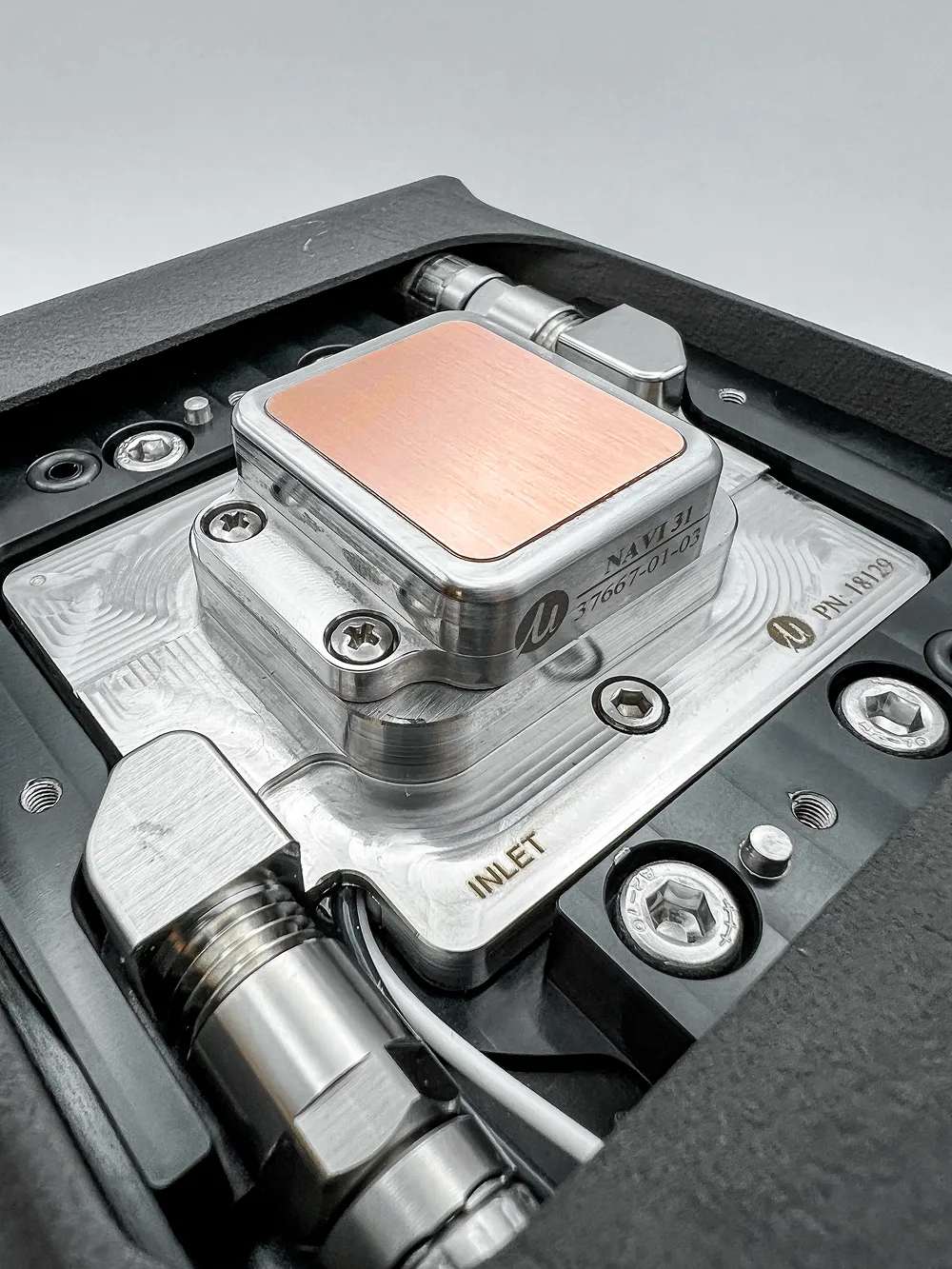
That deep experience in semiconductor thermal management gave Mikros Technologies an unusually early understanding of where data center cooling was headed. More than a decade ago, when most facilities relied on air cooling, the company was already customizing direct-to-chip liquid cooling solutions for a small number of forward-looking customers using high-performance processors and early AI systems for commercial applications. Those projects helped shape Mikros Technologies’ understanding of the data center ecosystem in ways that continue to inform its engineering today.
The Jabil Integration: From Boutique Engineering House to Global Scale
As computing demands accelerated, the thermal challenges Mikros Technologies had long addressed in specialized environments became essential to modern system design. What had once been niche became increasingly central to high-performance computing and AI infrastructure, as rising heat densities pushed traditional cooling approaches toward their limits.
That shift created a natural alignment with Jabil. The two organizations share an engineering-first approach to solving complex technical problems and bring complementary strengths to the partnership. Mikros Technologies contributes decades of specialized thermal expertise and proprietary liquid cooling technologies developed through advanced semiconductor and aerospace-related applications. Jabil adds global manufacturing scale, supply chain depth, and automation capabilities across its worldwide operations network.
Jabil's acquisition of Mikros Technologies in October 2024 expanded the company’s ability to deliver advanced liquid cooling solutions at volume, across regions, and into a broader range of applications than either organization could have supported independently. Drew Matter, President and CEO of Mikros Technologies, described the resulting synergies this way: “Since Mikros Technologies joined Jabil, we’ve shared a vision to expand globally. We now have the capacity to deliver our advanced liquid cooling engineering and manufacturing expertise at scale and across technological platforms.”
Throughout its history, Mikros Technologies has operated as a collaborative engineering partner, working closely with customers to optimize cooling solutions from the component level through full system integration. Within Jabil’s global manufacturing network, that engineering expertise can now support a far broader range of customers, industries, and deployment environments.
Scaling Thermal Expertise Across Industries
Mikros Technologies and Jabil worked together for years before the acquisition, with the company supplying cold plates to support one of Jabil’s fast-growing data center infrastructure customers. That partnership gave Jabil direct visibility into the quality and reliability of Mikros Technologies’ engineering and manufacturing expertise, particularly when compared against other approved suppliers.
The engineering and thermal expertise built over decades of complex research and development work now applies directly to high-performance computing, AI, networking, and optics — any application where heat flux densities are rising, space is constrained, and efficiency is critical.
As a Jabil company, Mikros Technologies delivers this expertise to customers at scale, with manufacturing capabilities across North America, Europe, and Asia. Customers gain access to in-region production that reduces lead times and simplifies supply chain logistics.
Whether the challenge is cooling next-generation AI accelerators and network switches in a hyperscale data center, managing heat in electric vehicle power systems, or enabling rapid semiconductor testing, the underlying engineering discipline is the same: characterize the heat flows, design for them from first principles, and deliver a solution that performs reliably where it matters most.
For teams working through thermal management decisions, Mikros Technologies is built to be a trusted engineering partner at any stage of the design process.
Ready to discuss your thermal management challenges? Contact the Mikros Technologies team.
About the Author:
Jesse McGowan is the Technology Enablement Director at Mikros Technologies, where he oversees engineering, manufacturing, and program delivery for advanced liquid-cooling and precision micromachined solutions supporting AI, HPC, and next-generation electronics. Since joining Mikros Technologies in 2003, he has held roles in R&D, engineering, manufacturing, and executive leadership. Following the company's acquisition by Jabil in 2024, Jesse played a key role in integrating the company’s technology with Jabil’s global scale to accelerate high-volume production. He holds a B.S. in Mechanical Engineering and an M.B.A. from the University of New Hampshire.
We work directly with your team to drive your business success.
You can find answers to many of our frequently asked questions.
Explore fully-integrated liquid cooling solutions at scale.